CERN Finds Evidence of an Extremely Rare Particle Decay After a 42-Year Search
After more than 40 years of searching, scientists at CERN have found the first evidence from a single experiment of an extremely rare particle decay involving a B⁰ meson transforming into two muons. The LHCb experiment recorded a statistical significance of 3.2 sigma, bringing researchers closer to understanding rare particle interactions and testing the limits of the Standard Model. Although the result is not yet a confirmed discovery, it marks an important milestone in modern particle physics.
After more than four decades of searching, physicists working at CERN have found the first evidence from a single experiment of an extraordinarily rare particle decay.
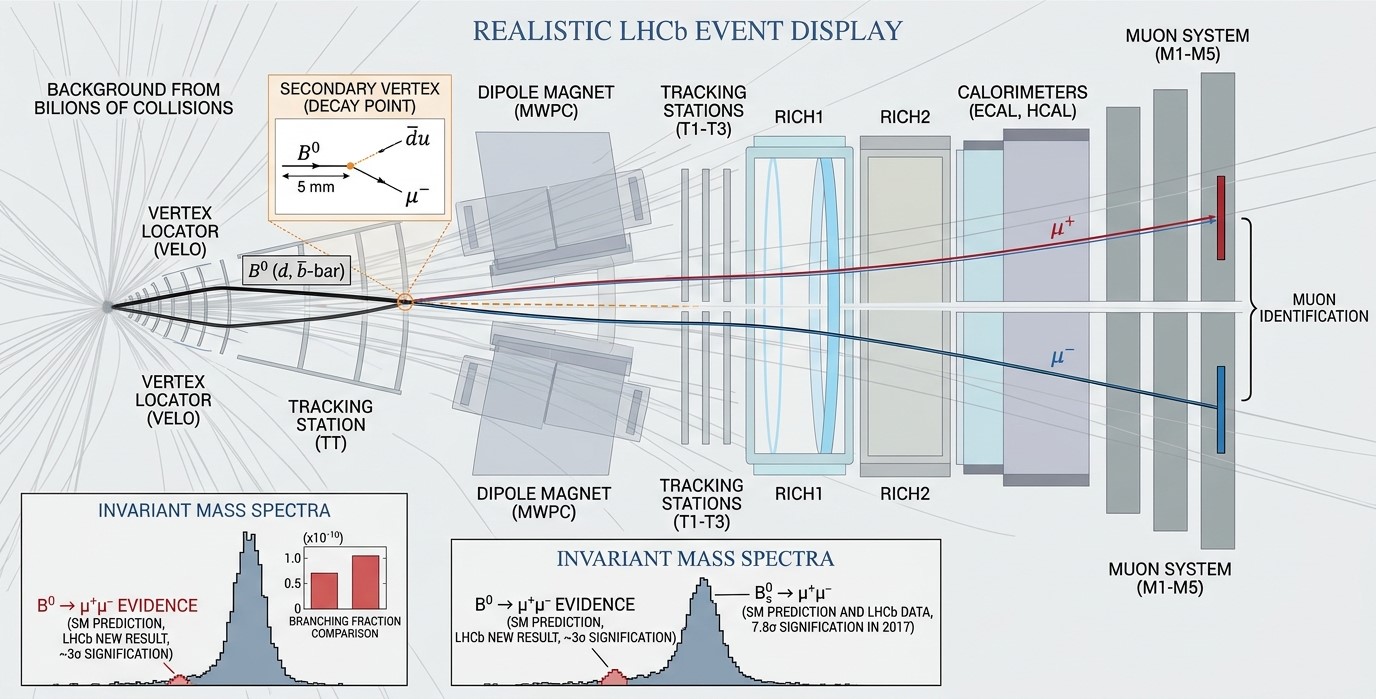
The process involves a subatomic particle called a B⁰ meson transforming into two muons, and it is expected to occur only about once in every 10 billion B⁰ mesons.
The finding comes from the LHCb experiment at the Large Hadron Collider. Researchers report a statistical significance of 3.2 standard deviations, an important milestone, although it falls short of the five-standard-deviation threshold generally required to claim a discovery in particle physics.
The result gives scientists a new way to test the foundations of modern physics and investigate whether undiscovered particles or forces could exist.
A search that lasted more than 40 years
The search for this particular particle decay began in the early 1980s.
Physicists have spent decades trying to identify the process because it is extraordinarily uncommon. Even when the Large Hadron Collider produces enormous numbers of particle collisions, detecting such a rare event requires sophisticated instruments and careful analysis.
The LHCb collaboration announced its latest result on November 3, 2026. The analysis used data collected by its upgraded detector during 2024 and 2025, combined with earlier measurements from the first and second runs of the Large Hadron Collider.
The combined dataset finally provided enough evidence for researchers to identify the signal.
The decay is written as:
B⁰ → μ⁺μ⁻
In simple terms, a B⁰ meson transforms into two particles called muons: one positively charged and one negatively charged.
It is one of the rarest particle decays ever studied at the LHC.
What exactly is a B⁰ meson?
To understand the finding, it helps to look at what these particles are.
A B⁰ meson is a short-lived subatomic particle made from two smaller components: a beauty quark and a down antiquark.
Beauty quarks are among the heavier types of quarks. They are not the same as the particles that make up ordinary matter in everyday objects, but they play an important role in experiments investigating the fundamental structure of the universe.
These particles exist for an extremely short time before decaying into other particles.
In this particular case, researchers are interested in a decay that produces two muons.
Muons are similar to electrons because they carry an electric charge, but they are much heavier. They are also unstable, eventually transforming into other particles.
The challenge is that the B⁰ meson's decay into two muons is predicted to happen so rarely that researchers must separate a tiny signal from an enormous amount of background activity.
Why is this decay so important?
The importance of the result goes beyond observing an unusual particle interaction.
The decay is particularly interesting because the Standard Model of particle physics predicts its behaviour with considerable precision.
The Standard Model is the leading scientific framework describing the fundamental particles that make up matter and the forces through which they interact.
It has successfully explained a remarkable range of experimental results. However, scientists know it does not provide a complete explanation of the universe.
For example, it does not explain the nature of dark matter or why the observable universe contains far more matter than antimatter.
This is why physicists continue looking for evidence that might point beyond the Standard Model.
Extremely rare particle decays offer one way to do this.
Some theoretical models predict that undiscovered particles could influence how frequently certain decays happen. Even if those hypothetical particles cannot be produced directly in an experiment, their effects might appear in the behaviour of particles that scientists can observe.
A rare particle decay can therefore provide clues about particles and forces that have not yet been discovered.
If the measured decay rate differed significantly from the Standard Model prediction, scientists would have a reason to investigate whether new physics was involved.
In this case, the measured result remains consistent with the Standard Model.
That does not make the research unimportant. It places tighter constraints on some theories that predict different behaviour.
What does 3.2 sigma actually mean?
One of the most important details in the announcement is the statistical significance of the result.
The LHCb collaboration reports a significance of 3.2 sigma after combining its new measurements with earlier data.
In particle physics, sigma describes how strongly an experimental result stands out from what scientists would expect from random background fluctuations.
A result around three sigma is generally described as evidence. The widely accepted threshold for claiming a discovery is five sigma.
This distinction matters.
A 3.2-sigma result is significant enough to support the conclusion that researchers have evidence of the decay. However, it is not strong enough to meet the conventional discovery standard.
In other words, CERN has not announced a new particle discovery. It has reported the first single-experiment evidence for this particular decay.
Reaching the five-sigma threshold would require stronger statistical evidence, potentially through additional observations and improved measurements.
How the upgraded LHCb experiment helped
The result was made possible partly by improvements to the LHCb detector.
The experiment received a major upgrade ahead of the Large Hadron Collider's third run. Its upgraded system can record proton-proton collisions at a rate up to five times higher than before.
That matters because rare particle decays require enormous datasets.
The more collisions researchers can record and analyse, the greater their opportunity to identify unusual events.
However, collecting more data is only part of the challenge. Scientists must also distinguish genuine signals from background events that can produce similar measurements.
The LHCb team used improved particle identification and advanced analysis techniques to separate the two-muon signal from the much larger background.
The collaboration also reported improved measurements of a related decay involving the B⁰s meson, another particle containing a beauty quark.
These measurements provide additional ways to test theoretical predictions.
What happens next?
The research is an important step, but scientists still have more work ahead.
The current result is based on a combination of measurements from different periods of the Large Hadron Collider's operation. Further data could improve the precision of the measurement and help determine whether the result remains consistent with the Standard Model.
LHCb is also preparing for another major upgrade expected to increase its data collection capabilities further.
With more observations, researchers hope to study rare particle processes with greater precision and investigate possible differences between experimental results and theoretical predictions.
The collaboration's latest findings have been submitted for publication, and the scientific community will continue examining the analysis.
A small signal with enormous scientific importance
The discovery of evidence for this rare decay does not mean physicists have found a new fundamental force or overturned existing theories.
What it demonstrates is how much can be learned by studying processes that happen incredibly rarely.
A particle interaction occurring roughly once in 10 billion B⁰ mesons may seem insignificant. Yet its behaviour can help scientists test some of the most important ideas in modern physics.
The result also shows the value of long-term scientific research. A search that began more than 40 years ago has now reached an important milestone because of better instruments, larger datasets and improved analytical techniques.
The Standard Model remains consistent with the latest measurements. But the search for what lies beyond it continues.
Sometimes, the smallest signals can offer some of the biggest clues about how the universe works.
Europe's Euclid Telescope Maps More Than 900 Million Galaxies in Major New Cosmic Data Release
Next Dispatch →Global EV Sales Reach 2.09 Million in October
Discussion (0)
Technical commentaryLeave a Reply
No comments yet. Be the first to share your thoughts!