Europe's Euclid Telescope Maps More Than 900 Million Galaxies in Major New Cosmic Data Release
The European Space Agency's Euclid space telescope has released its first major scientific dataset, revealing more than 900 million galaxies across a vast region of the sky. The observations include thousands of potential gravitational lenses that could help scientists investigate dark matter, dark energy and the evolution of the universe. The release marks a major milestone in humanity's effort to understand the invisible forces shaping the cosmos.
The European Space Agency (ESA) has released the first major dataset from its Euclid space telescope, revealing more than 900 million galaxies and giving scientists an extraordinary new resource for investigating the universe.
The release, announced on November 12, 2026, includes observations covering approximately 1,900 square degrees of sky, equivalent to around 14% of the area Euclid plans to survey during its six-year mission.
But this is about much more than counting galaxies. The mission is designed to help scientists investigate two of the biggest mysteries in modern physics: dark matter and dark energy.
The new observations are an important step toward building one of the most detailed three-dimensional maps of the universe ever created.
A massive new window into the universe
The new dataset, called Euclid Data Release 1 Foundation, contains approximately 1.7 petabytes of scientific data gathered during around 13 months of observations.
It includes images, spectra and other scientific measurements covering more than a billion astronomical objects.
Among its most significant findings are:
- More than 900 million galaxies.
- Approximately 60 million quasar candidates.
- Around 15,000 strong gravitational lensing candidates.
- Spectroscopic measurements from more than 160 million sources.
- Observations covering approximately 1,900 square degrees of sky.
To understand the scale, the observed area is equivalent to roughly 9,500 full Moons placed across the sky.
This is only a portion of Euclid's planned survey. The spacecraft is expected to map approximately one-third of the sky during its mission, giving astronomers an unprecedented view of how galaxies are distributed across cosmic history.
Why scientists are particularly interested in gravitational lensing
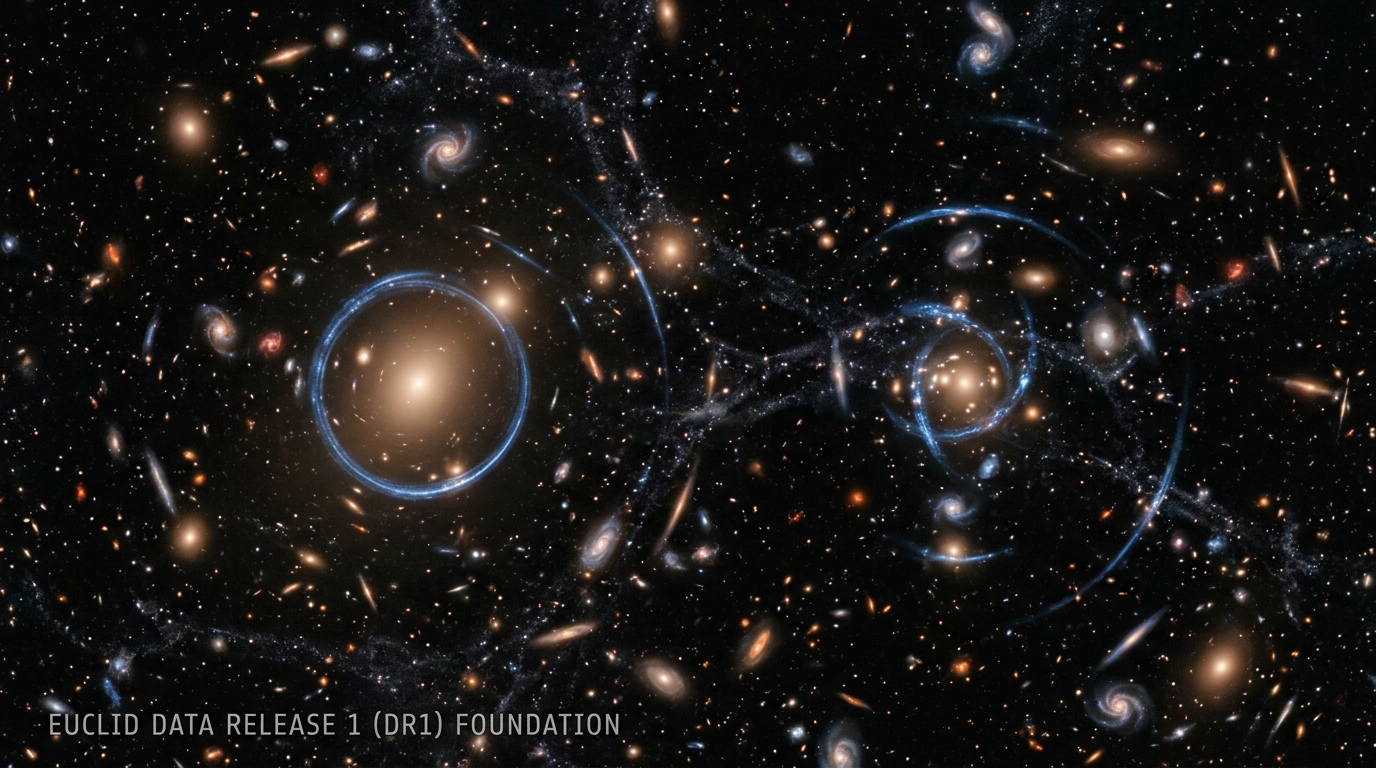
Among the most interesting discoveries in the dataset are approximately 15,000 candidates for strong gravitational lensing.
This phenomenon occurs when the gravity of a massive object, such as a galaxy, bends the light travelling from a more distant object behind it.
Imagine looking at a distant galaxy through a giant cosmic magnifying glass. The foreground galaxy bends the light, sometimes producing stretched arcs, multiple images or almost complete rings.
These unusual shapes are not simply beautiful astronomical photographs. They provide valuable scientific information.
The amount of light distortion depends partly on the distribution of mass in the foreground object, including material that cannot be seen directly.
That makes gravitational lensing an important way to investigate dark matter.
Previous catalogues contained far fewer examples. Euclid's new release provides the largest collection of strong gravitational lens candidates assembled to date, giving researchers a much larger sample to study.
Scientists can use these observations to examine how matter is distributed throughout galaxies and how cosmic structures have developed over time.
The mystery of dark matter and dark energy
To understand why Euclid matters, it helps to understand what astronomers are trying to investigate.
Everything we can directly observe, including stars, planets, gas and galaxies, represents only a small portion of the universe's total energy and matter content.
Current cosmological models estimate that ordinary matter accounts for approximately 5% of the universe.
Dark matter makes up roughly 27%, while dark energy accounts for approximately 68%.
Neither dark matter nor dark energy has been directly understood in the same way as ordinary matter.
Dark matter does not emit or reflect light in a way that allows us to observe it directly. However, scientists can infer its presence through gravitational effects on visible matter and light.
It helps explain why galaxies rotate and behave as they do, and how large cosmic structures form.
Dark energy, on the other hand, is the name given to whatever is driving the accelerated expansion of the universe.
Scientists know that the universe is expanding, but the underlying nature of dark energy remains one of the biggest unanswered questions in physics.
Euclid is designed to investigate these mysteries by studying the positions, shapes and distances of billions of galaxies.
By observing how galaxies are distributed across different periods of cosmic history, researchers can investigate how the universe expanded and how its large-scale structures developed.
How Euclid will build a three-dimensional map of the universe
Euclid is not simply taking photographs of distant galaxies. It is collecting measurements that allow scientists to estimate how far away those galaxies are and where they belong in the larger cosmic structure.
One important technique is spectroscopy.
When light from a galaxy is separated into its different wavelengths, scientists can examine how its spectrum has shifted. This provides information about its redshift, which helps estimate its distance and how far back in cosmic history we are observing.
Combining these measurements with galaxy images allows researchers to build a three-dimensional picture of the universe.
The resulting map will help scientists examine the cosmic web: the enormous network of galaxies, clusters and filaments separated by vast regions of relatively empty space.
The structure did not appear randomly. It developed over billions of years under the influence of gravity, dark matter and the expansion of the universe.
Euclid's observations will allow scientists to study this development across a much larger volume of space than previous surveys could cover.
What makes the Euclid telescope different?
Euclid was launched on July 1, 2023, and began its routine scientific observations in February 2024.
The spacecraft operates from space, above Earth's atmosphere, allowing it to capture exceptionally clear images across wide areas of the sky.
It uses two main scientific instruments.
The VIS instrument captures visible-light images with high resolution, allowing scientists to examine galaxy shapes and identify subtle distortions caused by gravitational lensing.
The Near-Infrared Spectrometer and Photometer (NISP) observes infrared light and helps scientists estimate the distances and other properties of galaxies.
Working together, these instruments provide complementary information that is essential for Euclid's scientific objectives.
The telescope was designed to observe enormous areas of the sky while maintaining the image quality needed to investigate subtle changes in galaxy shapes.
That combination of resolution and coverage is what makes the mission particularly valuable.
What happens next?
The November 12 release is the first major stage of Euclid's Data Release 1 programme.
A more complete release is expected in mid-2027, with additional scientific products covering galaxy clustering and weak gravitational lensing.
Researchers will use the newly available observations to investigate galaxy evolution, cosmic structure, gravitational lensing and the properties of dark matter.
Further results are expected as scientists analyse the data and compare their findings with existing cosmological models.
Euclid's mission is planned to continue through the end of this decade, with its wider scientific objectives extending into the early 2030s.
A new chapter in understanding the universe
For decades, astronomers have relied on increasingly powerful telescopes to look deeper into space and further back in time.
Euclid takes that effort in a different direction. Rather than concentrating only on individual distant objects, it is designed to map enormous regions of the universe and investigate how everything fits together.
The discovery of more than 900 million galaxies in this first major dataset demonstrates the scale of what the mission can achieve.
But the most important discoveries may still be ahead.
As scientists examine the gravitational lensing candidates, galaxy distributions and distant cosmic structures, the data could help answer fundamental questions about the composition and evolution of the universe.
We can see only a fraction of what the universe contains. Euclid is helping scientists understand the invisible forces shaping everything we can see.
Notion AI Data Breach Exposes Customer Chat Transcripts Through Third-Party Provider
Next Dispatch →CERN Finds Evidence of an Extremely Rare Particle Decay After a 42-Year Search
Discussion (0)
Technical commentaryLeave a Reply
No comments yet. Be the first to share your thoughts!